
AI and the Internet as a Fifth Major Leap in Evolutionary Complexity
Inside the transition, without a map
Humanity may be undergoing a fifth major transition in evolutionary complexity — comparable to the emergence of life or language — as AI and digital networks create a new plane of existence, and we lack the conceptual clarity to navigate it wisely.
Actions
The Source
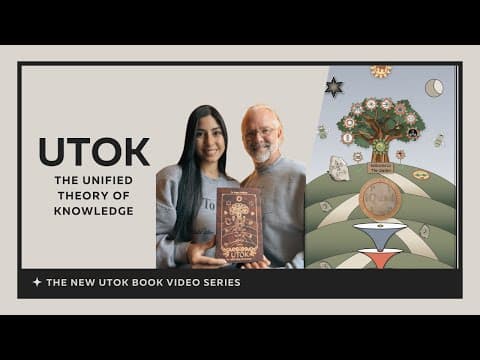
The New UTOK Book | Episode 2 | Architecture of UTOK and Book Outline
The Observer
UTOK framework, integrative metatheory — epistemology, philosophy of mind, and systems thinking in clinical psychology
The Translation
AI-assisted summaryFamiliar terms
The Tree of Knowledge framework, developed by Gregg Henriques as a core element of UTOK (Unified Theory of Knowledge), identifies a recurring structural pattern across evolutionary history: the Emergence of novel information-processing and communication networks generates qualitatively new complex adaptive planes of existence. Matter gave rise to Life through cellular communication. Neuronal networks gave rise to Mind and behavioral complexity. Propositional language gave rise to Culture — the person-culture plane. Each transition represents a genuine joint point where the architecture of complexity reorganizes at a higher order of integration.
The claim now being advanced is that artificial intelligence, large language models, the internet, and global digital infrastructure constitute a fourth such network — one that may be generating a fifth joint point and a new complex adaptive plane at civilizational scale. This is not reducible to technological acceleration or digital transformation in the conventional sense. It represents a Phase transition in the informational architecture of human civilization, analogous in structural significance to the Emergence of language itself.
What distinguishes this moment is that we are embedded within the transition without adequate metatheoretical frameworks or shared value structures to navigate it. UTOK frames the central challenge not as prediction but as orientation: how do we achieve sufficient conceptual clarity about the nature of this shift to organize knowledge and values coherently? The aspiration is to cultivate collective wisdom — what Henriques frames as becoming "Good Ancestors" — by developing the epistemic and ethical infrastructure needed to steward this transition toward well-being rather than fragmentation in the coming decades.