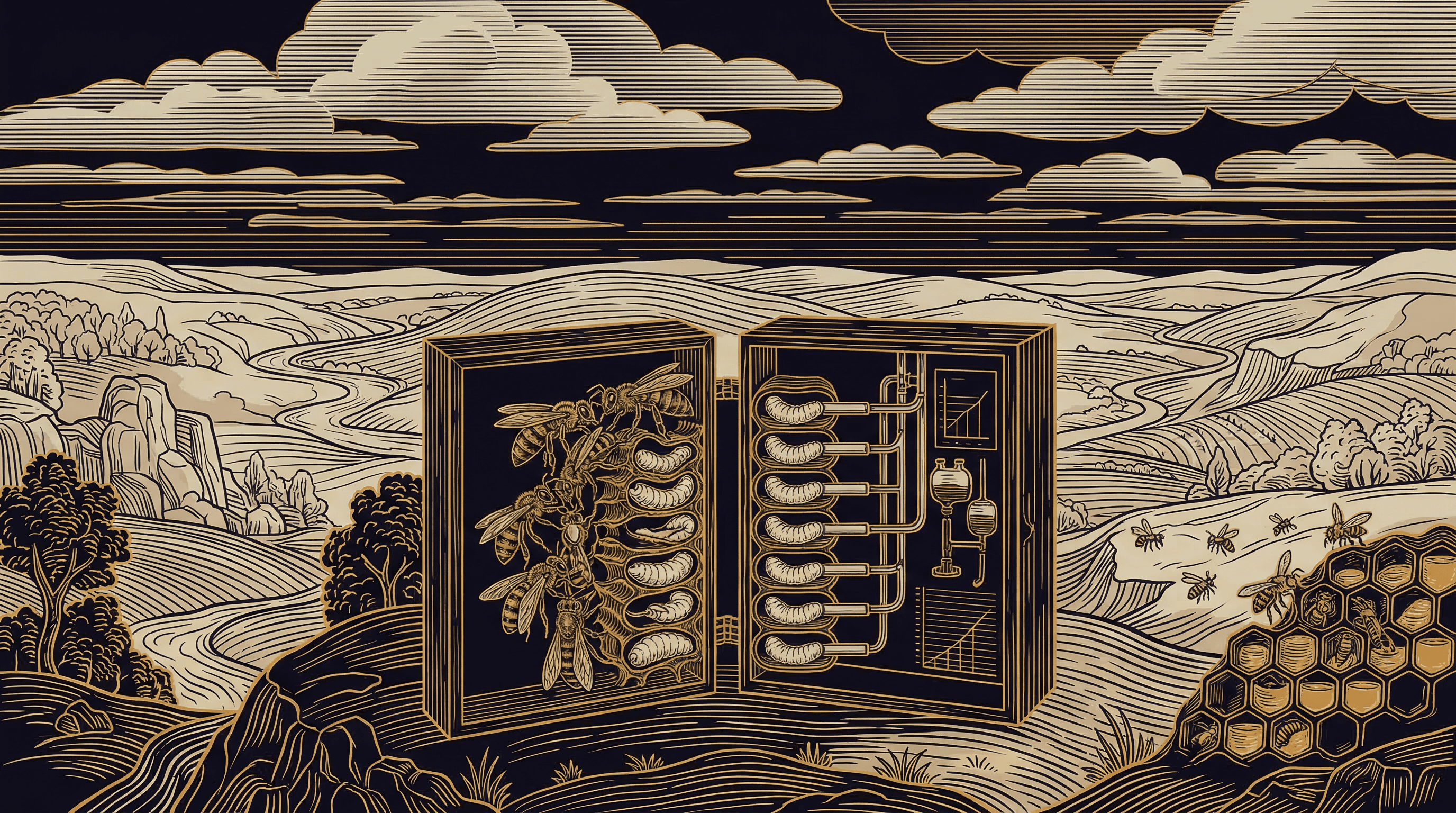
AI and the Systematic Replacement of Living Communication
Trading the pulse for the pattern
AI isn't a sudden rupture — it's the latest step in a long civilizational logic that breaks living relationships in the name of progress. The real risk is biological: life itself runs on communication, and we're replacing it without understanding what we're destroying.
The Translation
AI-assisted summaryFamiliar terms
The argument here is not that AI is catEgorically dangerous, but that it represents the latest and most potent expression of a civilizational logic — one embedded in industrial modernity — that systematically subordinates relational, embodied, and ecological processes to efficiency, control, and scalability. What is being disrupted is not merely social convention but something more fundamental: the communicative substrate of life itself. From intercellular signaling to intergenerational cultural transmission, living systems are constituted by multi-modal, relational exchange. Cognition, identity, and meaning do not arise in isolated processors — they emerge from dense webs of embodied interaction.
The educational domain makes this concrete. The transmission of culture across generations is not an information-delivery problem. It is a developmental, relational, and deeply embodied process — one that unfolds over two to three decades through sustained human-to-human contact: teachers, mentors, parents, peers. When that process is mediated or replaced by systems optimized for engagement and preference-satisfaction, the concern is not that learning metrics will decline. The concern is that the relational architecture through which values, identity, and cultural continuity are formed will be quietly hollowed out.
The Epistemological problem compounds the risk: the research infrastructure needed to assess what is being lost — to study the effects of degrading multi-modal, living communicative relationships at scale — does not yet exist. The experiment is already running. And it is running inside a cultural logic that has been eroding these same relational substrates for generations, which means the baseline against which harm might be measured is itself already compromised.