
AI Systems Producing Results Nobody Can Explain or Question
The answer arrived. The understanding did not.
The 'bronteroc' joke in Don't Look Up is more than absurdist comedy — it dramatizes the real and growing danger of epistemic debt, where AI systems produce predictions no one can explain, severing the link between knowledge and understanding at the worst possible time.
Actions
The Source
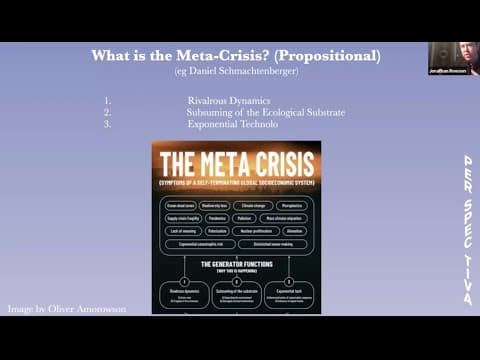
Don’t Look Up! The Meta-Crisis Is Not in the Sky w/ Jonathan Rowson
The Observer
Systems thinking, inner life, cultural transformation — sensemaking, dialogos, and the soul’s role in navigating civilizational crisis from Perspectiva
The Translation
AI-assisted summaryFamiliar terms
The "bronteroc" moment in Don't Look Up — where an opaque algorithm predicts the president's death by an uninterpretable creature — functions as a precise dramatization of what researchers call intellectual or epistemic debt. This concept describes the growing gap between the outputs AI systems produce and any human-legible understanding of how those outputs were generated. The prediction arrives without theory, without explanation, without any framework for assessing its reliability or boundaries. It is knowledge untethered from understanding.
This is not speculative. Contemporary machine learning systems, particularly deep neural networks, routinely generate high-confidence outputs whose internal logic remains inaccessible even to their designers. The epistemic structure is inverted: instead of theory generating predictions, predictions arrive absent theory. The consequence is that failure modes become invisible until they manifest, and the people making decisions on the basis of these outputs have no principled way to evaluate them. The old AI risk narrative — autonomous agents with misaligned goals — obscures the more immediate danger: a creeping dependency on systems whose correctness cannot be verified through any process resembling understanding.
The film extends this critique through the character of Peter Isherwell, whose proprietary asteroid-mining technology displaces the peer-reviewed scientific response. The catastrophic failure that follows is not merely a satire of tech-sector hubris. It dramatizes the structural consequences of Decoupling technological capability from accountability, peer review, and shared epistemic norms. When power can bypass the mechanisms a civilization uses to self-correct — open inquiry, reproducibility, theoretical grounding — the result is not just bad decisions but a fundamental erosion of the conditions under which good decisions remain possible.