
Quantum Mechanics Does Not Prove Many Worlds Exist
The equation is not the universe wearing a mask.
Quantum equations having many mathematical solutions doesn't mean many worlds actually exist — that's a category mistake. But quantum physics does reveal something real: nature involves genuine openness, not just ignorance, where possibilities are explored and selected in ways closer to decision than to determinism or randomness.
Actions
The Source
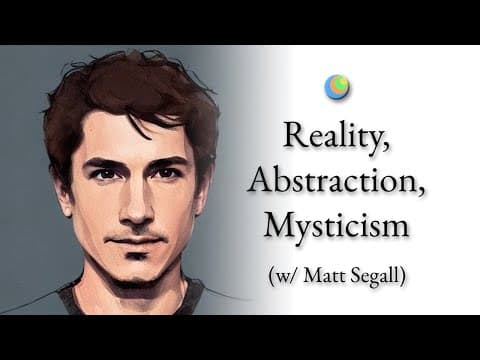
Metamodern Spirituality | Reality, Abstraction, Mysticism (w/ Matt Segall)
The Observer
Process-relational philosophy, Whitehead, consciousness — epistemology, ontological design, and re-enchanting cosmology from CIIS
The Translation
AI-assisted summaryFamiliar terms
The many-worlds interpretation exemplifies what might be called ontological overflow: the illegitimate move from the mathematical structure of a formalism to direct metaphysical conclusions. The Schrödinger equation admits infinitely many solutions; the many-worlds reading inflates this into infinitely many real branches of reality. This is a category mistake — treating abstract formalism as a transparent window onto ontology rather than as a predictive instrument. The resulting claim is in principle unfalsifiable, meaning it has crossed from physics into metaphysics without acknowledging the border.
Yet quantum mechanics does carry genuine ontological weight, properly interpreted. It suggests that nature is not exhausted by the actual — that possibility has a kind of reality alongside actuality, and that the transition from superposition to definite outcome involves something more than epistemic uncertainty. There appears to be an ontological openness at the heart of physical process, a real indeterminacy that is neither Einstein's hidden-variable determinism nor brute randomness.
Whitehead's process metaphysics provides a rigorous framework for articulating this. His notion of conceptual prehension describes how each occasion of experience inherits physically from its past (physical prehension) while also entertaining relevant eternal objects — pure possibilities — that shape what it becomes. At the quantum level, this interplay between conformity to the past and the ingression of novel possibility maps onto the observed behavior with striking precision. The result is a picture of nature as involving genuine selection among constrained possibilities — something closer to decision than to mechanism, though decision without consciousness. This preserves the legitimate philosophical implications of quantum theory while refusing the ontological extravagance of many-worlds.