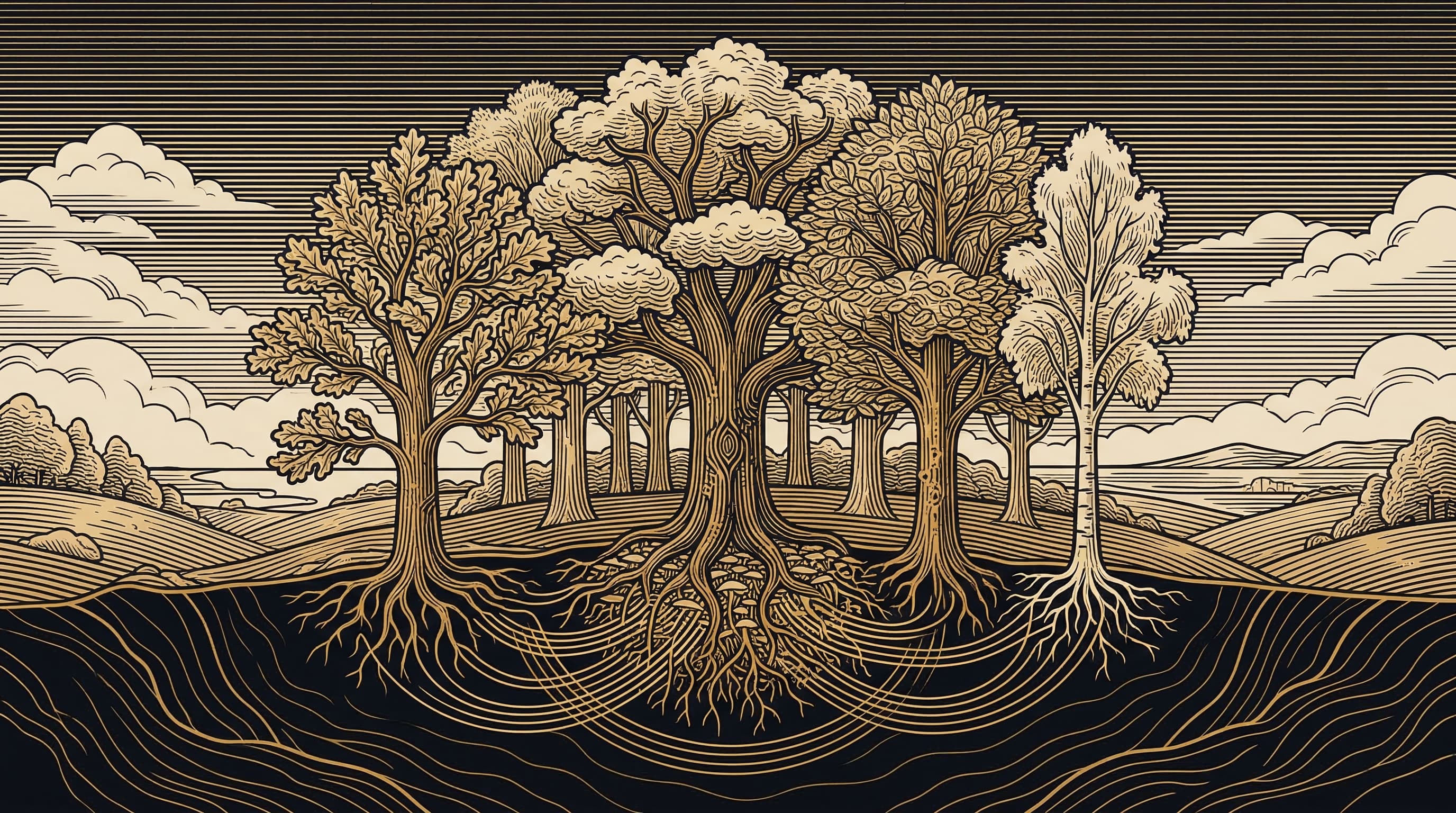
Biological Cooperation and the Myth of Perpetual Growth
The forest does not grow forever
Silicon Valley's 'survival of the fittest' logic misreads Darwin: real evolution favors cooperation and equilibrium, not endless growth and winner-take-all dominance. Nature's systems mature and stabilize — they don't grow forever.
The Translation
AI-assisted summaryFamiliar terms
A persistent conflation in Silicon Valley ideology maps Darwinian natural selection onto market competition, producing a narrative in which exponential growth and competitive dominance are not merely desirable but biologically ordained. This reading treats 'survival of the fittest' as a license for monopolistic accumulation. The argument advanced here is that this represents a fundamental misappropriation of evolutionary theory — one with serious ecological and economic consequences.
Evolutionary biology, properly understood, does not describe a world trending toward singular dominance. It describes co-evolutionary equilibria: dynamic, self-regulating systems in which no species achieves decisive or permanent victory. The average species persists for two to three million years, with population ranges fluctuating in response to climate, competition, and ecological pressures. The biosphere itself has maintained relative homeostasis across geological timescales. Mature ecosystems — old-growth forests being the canonical example — do not grow indefinitely; they reach a climax state characterized by complexity, redundancy, and resilience. Growth is a phase, not a permanent condition.
The monopolistic logic that Silicon Valley extracts from pseudo-Darwinian framing produces systems that are, paradoxically, far more brittle than the diverse competitive landscapes they displace. A monoculture — biological or economic — is catastrophically vulnerable to perturbation. The insight is pointed: the ideological weaponization of evolutionary language to justify extractive capitalism is not merely intellectually dishonest but ecologically catastrophic, because it normalizes as 'natural' a growth trajectory that natural systems have never, in fact, sustained.