Distinguishing Human Complexity from Biological Systems
Beyond the clockwork of the colony
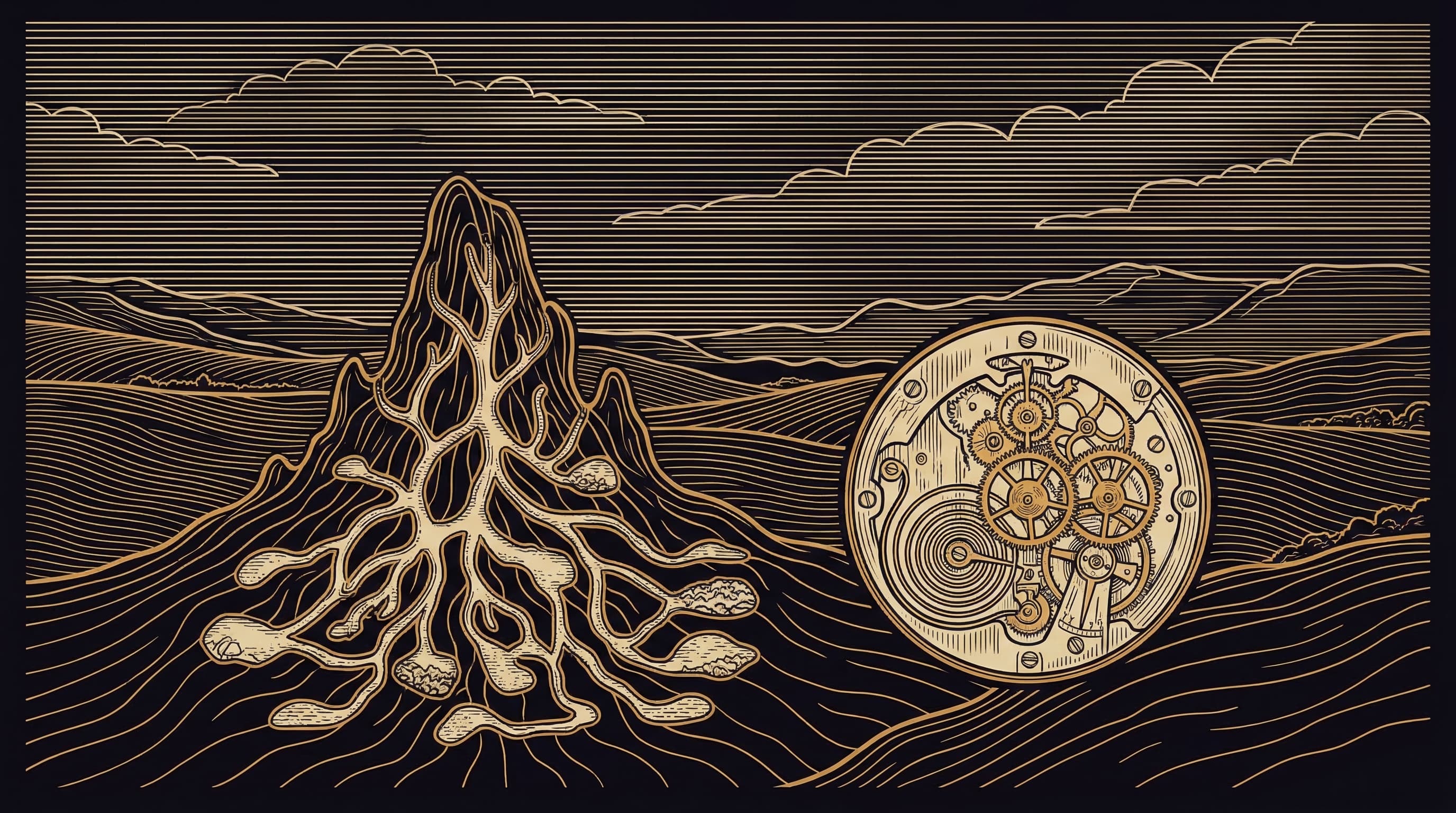
Human societies are not ant colonies — applying biological complexity models directly to human systems is a category error. Understanding human complexity requires accepting essential uncertainty, not just better simulations.
The Translation
AI-assisted summaryFamiliar terms
Early Complexity science drew its most compelling demonstrations from biological and physical systems: Prigogine's Dissipative Structures, Holland's adaptive fitness landscapes, the emergent division of labor in insect Superorganisms. The conceptual power of these models generated a strong temptation to port them directly into the social sciences and organizational theory. That temptation should be resisted. Human systems introduce properties — intentionality, narrative self-construction, cultural transmission, phenomenal consciousness — that are not merely additional variables but Ontologically distinct features that resist reduction to agent-based interaction rules.
The critique here is not that complexity theory is wrong, but that a naive transfer constitutes a lateral move rather than an explanatory advance. Replacing Newtonian linear causality with deterministic chaos or multi-agent simulation still preserves the implicit ambition of predictive modeling: get the inputs right and the outputs follow. This leaves intact the core error — treating Essential uncertainty as a technical problem to be solved rather than a structural feature of human systems to be understood.
What a genuinely Transdisciplinary approach demands is the integration of complexity theory with cognitive neuroscience, philosophy of mind, and anthropology. The hard problem of consciousness and questions of agency and free will do not dissolve under computational modeling; they require their own conceptual frameworks. Complexity science's most valuable contribution in this context is not a predictive toolkit but an Ontological one: it offers a framework in which diverse, irreducible system types can coexist without forcing a single explanatory register onto all of them.