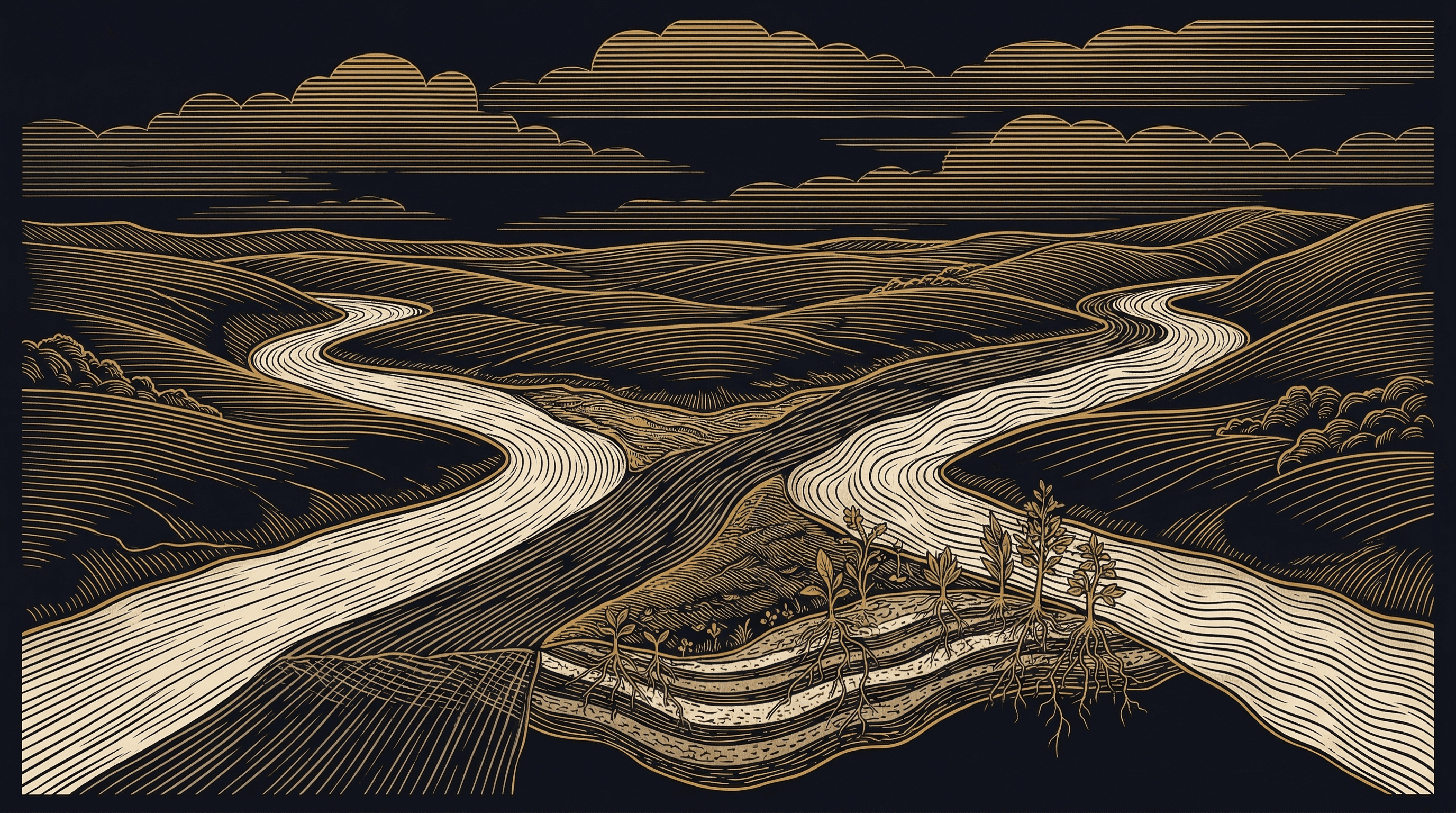
Folk Song Traditions and the Living Wisdom Commons
A thousand fires lit by no one
The wisdom tradition we're trying to build already exists — buried in American folk music. Bluegrass, blues, zydeco, and the songs Woody Guthrie passed to Pete Seeger encode a living system for spreading meaning without any central authority.
The Translation
AI-assisted summaryFamiliar terms
Jamie Wheal's concept of the 'Arcana Americana' proposes that the American folk tradition constitutes an already-existing wisdom commons — not a designed system but an emergent one, assembled from the collision of displaced cultures: Scots-Irish settlers, West African enslaved people, French Acadian exiles, and others who encoded their survival, grief, and transcendence into music. Alan Lomax's monumental fieldwork — over 10,000 recordings — documented the connective tissue of this tradition, revealing not a unified canon but a rhizomatic network of influence and transformation.
What makes this more than cultural history is the structural claim embedded in it. The folk transmission model — in which a Guthrie melody becomes a Seeger anthem becomes a Dead improvisation becomes a Coachella moment — demonstrates that meaning can propagate horizontally across time, geography, and social context without Institutional mediation. Wheal frames this as a kind of 'blockchain of transformational consciousness': a decentralized ledger of hard-won human experience, verified not by authority but by the lived testimony of those who suffered, prevailed, and sang about it.
The implication for anyone working on emergent knowledge commons or Collective sensemaking is significant. It reframes the design problem: rather than engineering new architectures for distributed wisdom, the more generative move may be to excavate and reanimate the transmission lineages that already exist beneath the surface of contemporary culture. The infrastructure is not missing — it is dormant, waiting to be recognized and re-engaged.