
Four Ways of Knowing the Metacrisis — From Theory to Lived Experience
I get it, but I don't see it.
The metacrisis isn't a list of separate problems but a set of deeper patterns generating all of them at once — and truly grasping this requires not just intellectual understanding but felt, lived, participatory knowing. The gap between 'getting it' and 'seeing it' is itself part of the crisis.
Actions
The Source
Don’t Look Up! The Meta-Crisis Is Not in the Sky w/ Jonathan Rowson
The Observer
Systems thinking, inner life, cultural transformation — sensemaking, dialogos, and the soul’s role in navigating civilizational crisis from Perspectiva
The Translation
AI-assisted summaryFamiliar terms
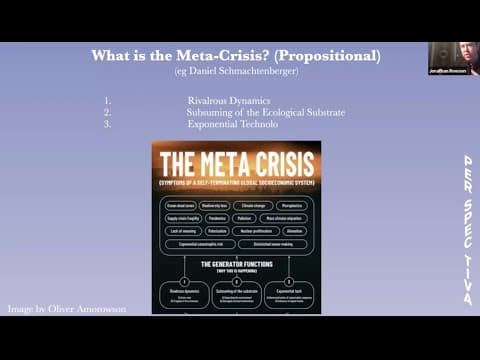
The metacrisis framework, as articulated most thoroughly by Daniel Schmachtenberger, identifies not a catalogue of discrete global risks but a set of generator functions producing them simultaneously. Three are especially central: rivalrous dynamics that lock actors into escalatory competition regardless of downstream harm; the subsumption of ecological substrate, where regenerative natural capital is consumed faster than it replenishes — spending principal rather than interest; and the ungoverned proliferation of exponential technology into private hands. These patterns are structurally entangled, meaning interventions targeting any single crisis without addressing the generators tend to displace harm rather than resolve it.
The critical move in this insight, however, is epistemological. Propositional knowledge of the metacrisis — understanding the game theory, the dynamics, the structural analysis — is necessary but radically insufficient. There are at least four ways of knowing what is happening, and the most neglected are procedural and participatory: living with questions like 'What is actually going on and how do we know?' and 'What does a viable future feel like?' These questions co-arise and cannot be resolved sequentially. They must be inhabited.
The gap between comprehension and participation is itself a symptom of the metacrisis. Schmachtenberger's exchange with Joe Rogan — 'I get it, but I don't see it' — crystallizes the problem. The film Don't Look Up functions not as climate allegory but as a vehicle for felt, vicarious knowing: it renders the texture of metacrisis — dysfunctional media, captured politics, fractured relationships — as lived experience rather than analytical description. Until discourse moves from describing the pickle to tasting it, the kind of collective awakening required remains structurally out of reach.