
From Tribal Intimacy to Global Institutional Systems
The machinery that outgrew its makers
Every civilization from Rome to the present runs on the same basic operating system — hierarchy, money, and law — and that system is now hitting the limits of what it was ever capable of solving.
Actions
The Source
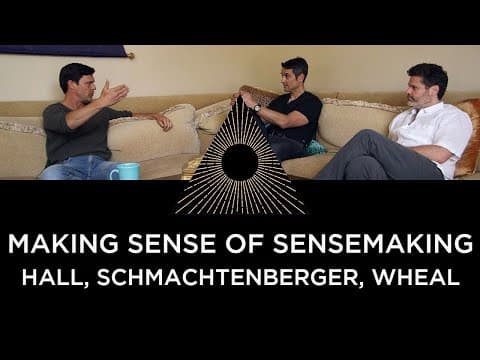
Making Sense of Sensemaking: Daniel Schmachtenberger, Jamie Wheal, Jordan Hall
The Observer
Distributed governance, collective intelligence, game B — epistemology, sense-making, and the design of resilient social systems
The Translation
AI-assisted summaryFamiliar terms
The concept of 'Dunbar coherence' names the form of social organization that emerged during the upper paleolithic transition, when humans developed the Cognitive capacity for culture: the ability to model other minds, track complex relational webs, and coordinate behavior through shared symbolic frameworks. This capacity was extraordinarily adaptive, enabling humans to occupy every ecological niche on the planet. Its constraint is well-documented — the neocortical ceiling at roughly 150 individuals beyond which this form of coherence degrades.
The pressure of inter-group competition and resource scarcity created selection pressure for a qualitatively different coordination mechanism. What gets called 'Game A' is the entire family of solutions that civilizations converged upon: formal hierarchy, monetary abstraction, codified law, and transmissible Semantic narratives. These are not merely social conventions but computational strategies — they reduce the Irreducible complexity of human relationships into legible, repeatable inputs and outputs that can function at population scales far beyond Dunbar's limit. The Ming Dynasty, the Roman Empire, and contemporary liberal democracies are all variations within this same Possibility space.
The critical insight is architectural rather than political. Game A did not fail through corruption or mismanagement alone — it is approaching the boundary conditions of what its structure can process. The coordination problems now facing civilization, including ecological overshoot, multipolar traps, and the collapse of institutional trust, are not bugs within Game A but emergent properties of its core logic. This framing reorients the question: not how to reform existing institutions, but whether a successor coordination architecture is possible.