
How Objective Science Grew From Subjective and Cultural Knowing
The world split into three, and forgot.
Subjective experience, shared culture, and objective science emerged in that evolutionary order — yet modern thought treats science as if the other two don't exist. Recognizing all three as irreducible vectors of knowing, and mapping how they relate, is the key to closing the Enlightenment Gap.
Actions
The Observer
UTOK framework, integrative metatheory — epistemology, philosophy of mind, and systems thinking in clinical psychology
The Translation
AI-assisted summaryFamiliar terms
A crucial but underappreciated insight concerns the evolutionary and historical sequence of the three vectors of empirical knowing. Subjective phenomenological experience is the most ancient: it arose with sentient animals encountering the world as subjects. The intersubjective vector emerged later, as language-using primates built propositional networks — shared beliefs, norms, and narratives — that constituted cultural identity. Only from within that intersubjective cultural substrate, through the refinement of mathematics, Socratic demands for Justification, and experimental method, did the objective vector of modern natural science crystallize. Science is thus not independent of culture; it is enabled by it, even as it achieves claims intended to transcend any particular perspective.
The Enlightenment's great success was factoring out the subject to produce objective knowledge. Its great failure — what Henriques terms the Enlightenment Gap — was allowing that move to metastasize into the assumption that subjectivity and intersubjectivity are epistemically negligible or reducible to objective description. The result is a fractured intellectual landscape in which three genuinely irreducible modes of knowing coexist without a coherent metatheoretical picture relating them.
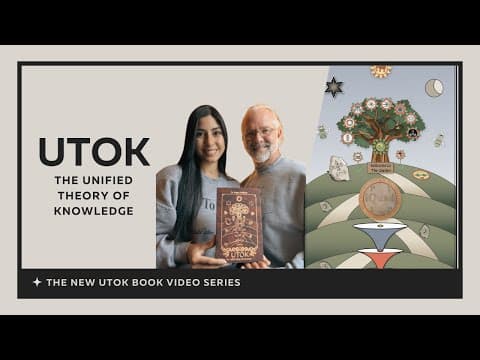
Donald Davidson articulated the puzzle with precision: any adequate philosophy must accommodate subjective experience, intersubjective agreement, and objective reality, making their relations to one another transparent. Without such a picture, the fact that one world yields three radically different epistemic modes should strike us as deeply mysterious. UTOK's three core pillars — the Tree of Knowledge System, the iQuad coin, and the Garden — are proposed as exactly this integrative architecture: a framework that holds science, phenomenology, and culture in coherent relation without collapsing any into the others.