
How Personal Identity and Cultural Worldview Share the Same Epistemic Architecture
The self, writ large.
Every person and every culture builds knowledge the same way: by weaving pre-existing concepts together with observed experience. Personal identity and large-scale worldviews like religions or political ideologies share identical architecture — they are justification systems that scale.
Actions
The Source
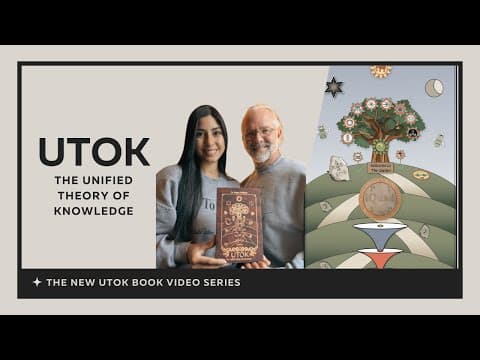
The New UTOK Book | Ep 8 | The UTOK Garden frames the Intersubjective Vector of Knowing (Ch 6)
The Observer
UTOK framework, integrative metatheory — epistemology, philosophy of mind, and systems thinking in clinical psychology
The Translation
AI-assisted summaryFamiliar terms
At the foundation of human knowing lies a persistent dialectic between metaphysics and empiricism. metaphysics, in this usage, does not refer to mysticism but to the propositional, pre-empirical framework of concepts and categories through which experience is organized before any data arrives. Empiricism refers to the observational stream — sensory data, measurement, encounter. Personal identity is best understood as a metaphysical-empirical system: a network of interpretive structures continuously updated and confirmed by incoming evidence. This is not merely a philosophical abstraction; it is the operative architecture of how any individual justifies beliefs and navigates the world.
The same architecture scales. Every large-scale culture operates through a Memeplex — a self-reinforcing belief-value network that binds people through shared Justification systems. Christianity, scientific materialism, progressive liberalism — each carries descriptive and normative narratives and selectively organizes empirical facts around them. The Meme Flower model within Gregg Henriques' Unified Theory of Knowledge (UTOK) framework makes this scaling visible, mapping how individual justificatory systems aggregate into collective ones while retaining the same dialectical structure.
This perspective dissolves a common confusion: the assumption that personal belief formation and cultural worldview construction are fundamentally different kinds of processes. They are not. They are the same epistemic process operating at different scales. The implication is consequential — cultivating epistemic wisdom at the individual level is not merely analogous to cultivating it at the collective level, it is the same structural challenge. A wiser self and a wiser civilization require the same kind of work: honest integration of conceptual frameworks with empirical reality, and willingness to revise both.