How Purpose Emerges from the Physics of Absence
The hollow space that moves the world
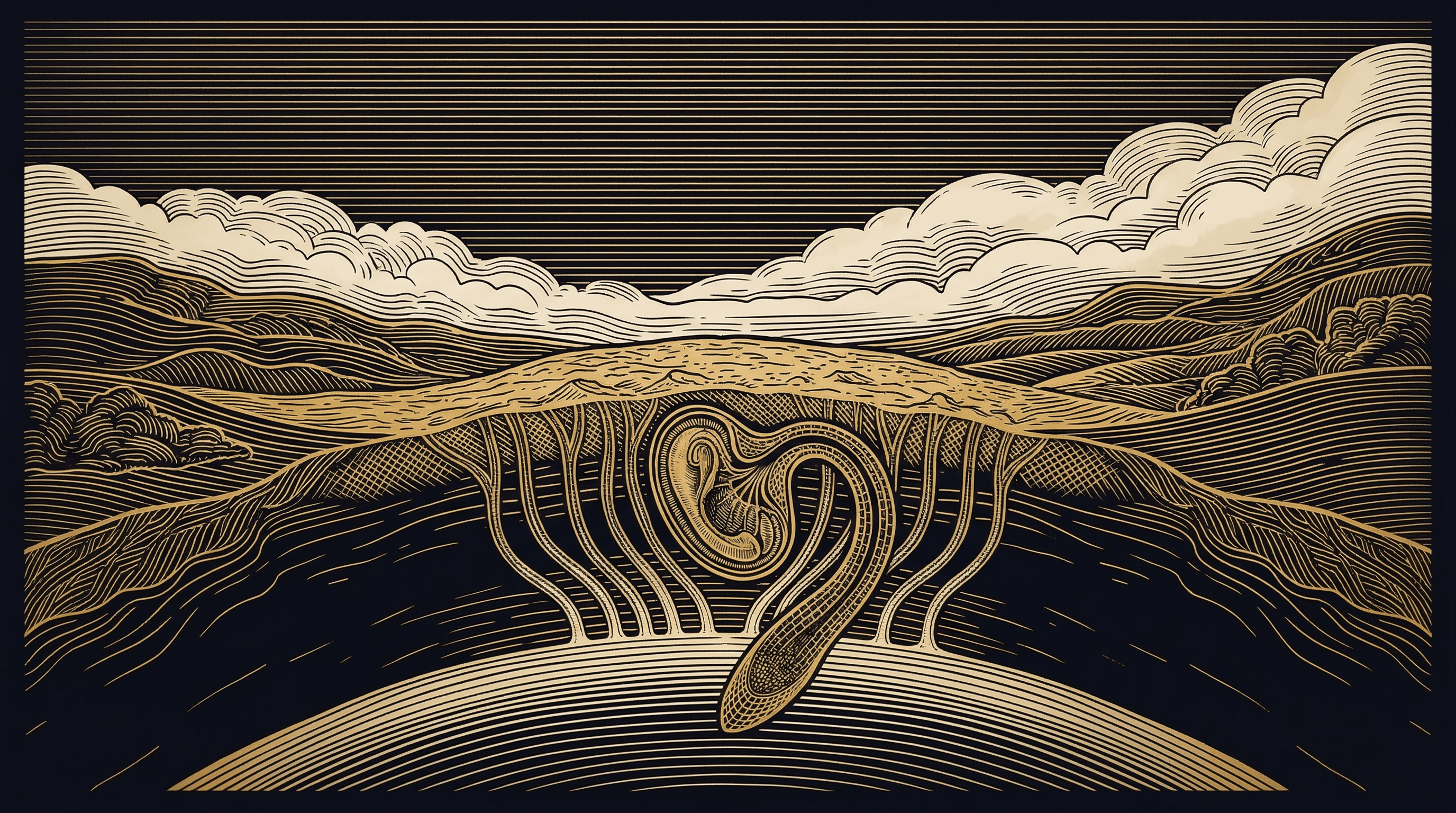
Terence Deacon rescues purpose and meaning from the exile Darwin imposed, showing that goal-directedness is a real physical phenomenon grounded in absence — in what a system is organized toward but does not yet have.
The Translation
AI-assisted summaryFamiliar terms
Since Darwin, Teleology was treated as a conceptual embarrassment in the natural sciences — a relic of pre-scientific thinking to be replaced entirely by efficient and material causation. Terence Deacon's project, most fully articulated in 'Incomplete Nature,' constitutes a serious attempt to rehabilitate Final causality within a rigorously naturalistic and emergentist framework, without reintroducing vitalism or dualism.
Deacon's central move is to locate the causal efficacy of purpose, meaning, and intentionality in their intrinsic Incompleteness. These phenomena are not defined by any positive substrate but by their constitutive orientation toward an absent referent or goal state. The absence is not merely descriptive — it is dynamically efficacious. A system organized around what it is not yet, or what it lacks, is genuinely caused to behave in consequence-organized ways. Deacon coins the term 'Ententional' to name this class of phenomena, which includes everything from thermodynamic Dissipative Structures and homeostatic organisms to semiotic processes and conscious intentions.
This framework allows for a continuous, non-reductive account of Emergence across levels of complexity. Each level — from chemistry to biology to mind to culture — exhibits increasingly sophisticated forms of absential causation, where the organizing principle is a future or ideal state rather than a prior efficient cause. The causal power is located not in any ultimate stuff but in dynamical organization itself, dissolving the hard boundary between the physical and the intentional without collapsing one into the other.