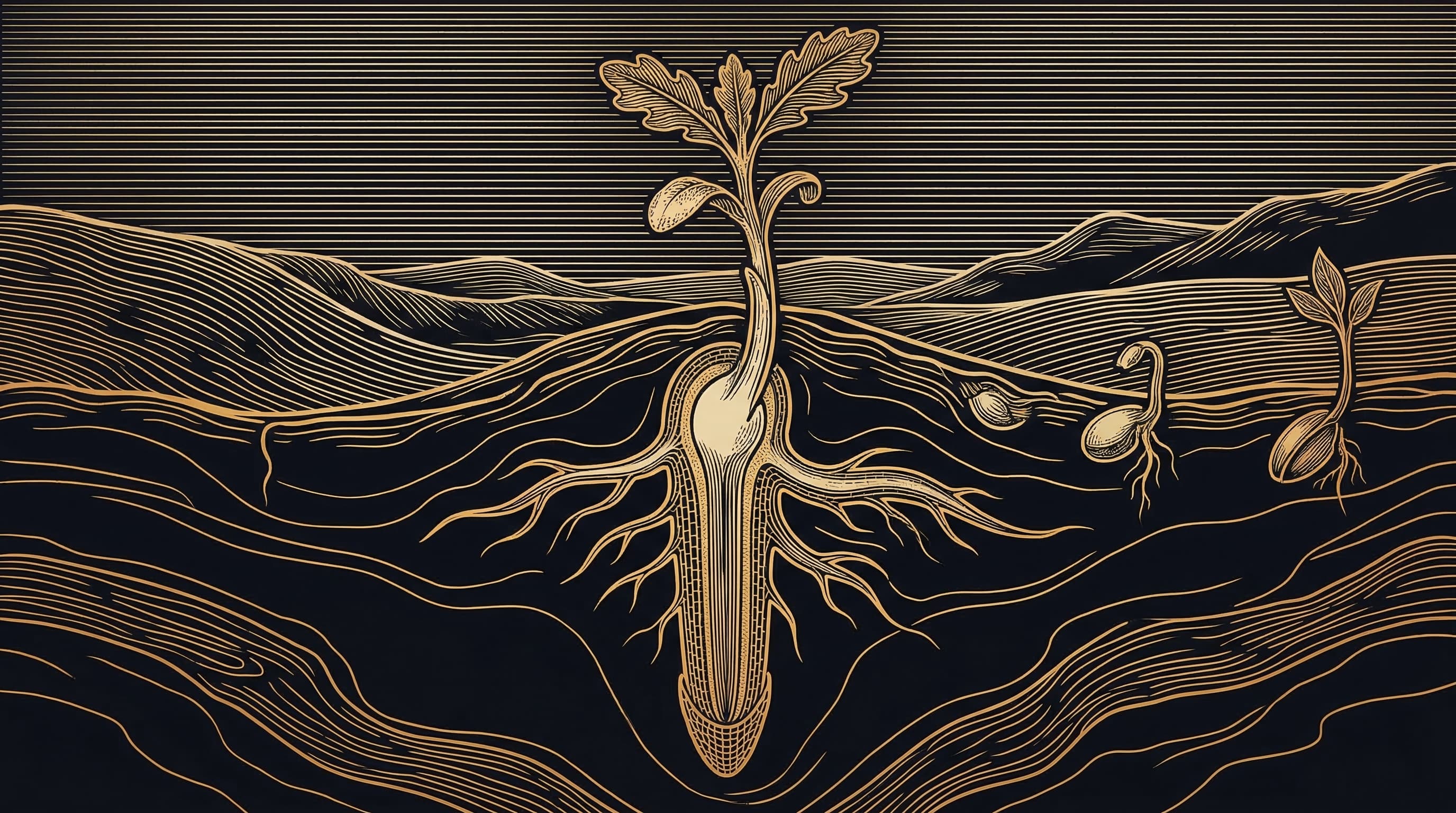
How Whole Systems Generate Their Own Components
The loom that weaves its own thread
In living systems, the whole doesn't just emerge from the parts — it actually creates them. This reversal of reductionism has profound consequences for how we design, reform, and intervene in anything that grows.
The Translation
AI-assisted summaryFamiliar terms
Complexity science is widely understood to vindicate Emergence — the idea that novel, irreducible properties arise from interactions among simpler components. This is a genuine and important insight. But there is a deeper, more unsettling claim that tends to get lost: in organic, developmental systems, the causal arrow doesn't just run upward from parts to wholes. It runs the other way. The whole system actively constitutes the Functional identity of its parts.
Chris Alexander's later work gestures toward this inversion. A living structure isn't assembled from pre-specified components; it grows through a process in which each differentiation is shaped by the context the whole provides. The functional character of any given part — what makes it the kind of part it is — is inseparable from the developmental history and organizational logic of the system that generated it. This is catEgorically different from standard Emergence, which still treats the parts as Ontologically primary and the whole as derivative. Here, the whole has a kind of causal and Ontological priority.
The implications for intervention are serious. Conventional reform strategies — whether in Institutional design, urban planning, or organizational change — tend to import the logic of artificial construction: decompose, redesign components, reintegrate. But if component identity is itself a product of systemic history and relational context, component-swapping is likely to fail or produce unexpected degradation. Effective intervention requires engaging with the Generative logic of the whole — its developmental grammar, so to speak. This represents a genuine frontier, one that complexity thinking has named but not yet fully theorized.