
How Words Encode Worldviews: The Hidden Ontology of Everyday Language
The groove you didn't know you were already in.
New vocabulary like 'regenerative' can open genuine possibilities, but only if the underlying way of seeing actually shifts. Some words — like 'impact' — quietly smuggle mechanistic assumptions into conversations about living systems, foreclosing the relational perception they claim to serve.
Actions
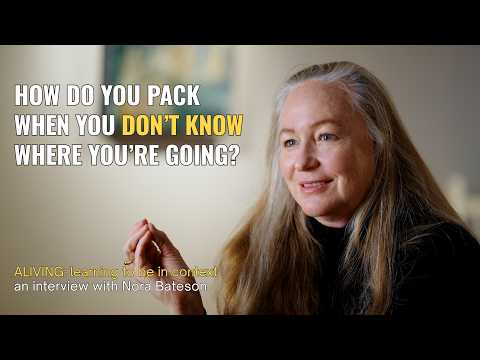
The Observer
Systems thinking, symmathesy, warm data — contextual mutual learning in living systems and the relational complexity beneath social and ecological crises
The Translation
AI-assisted summaryFamiliar terms
This insight positions language as one of the few genuinely unstuck dimensions of contemporary discourse — a site of real generative potential. The term 'regenerative,' for instance, opens conceptual space that 'sustainability' and 'resilience' structurally could not. Yet the argument insists that lexical substitution without perceptual shift is merely iterative: anticolonialism, transdisciplinarity, consciousness — any term becomes another groove if the underlying ontological orientation remains unchanged. The diagnosis is that vocabulary change often functions as a surface-level move within a deeper game that continues unaltered.
A particularly sharp observation concerns words that covertly import mechanistic ontology into discourse about living systems. 'Impact' is identified as paradigmatic. Its etymology and usage frame causation as linear and Newtonian — one discrete body striking another, with measurable displacement. This framing systematically forecloses relational, temporal, and emergent dimensions: how an action reverberates through webs of mutual relationship, alters future speech and agency, transforms the actor, and travels unpredictably through history. The word does not merely fail to capture these dynamics — it actively renders them invisible by design.
The insight extends to the social process of language change itself. When linguistic correction becomes punitive — when people are condemned for not yet understanding why certain language causes harm — relationship is severed. And relationship is precisely the medium through which entrenched perceptual habits can actually shift. Without it, those habits do not dissolve; they fortify. The implication is that language change must be held as relational practice rather than ideological enforcement, or it reproduces the very rigidity it seeks to overcome.