
Humanity as a Constitutively Technological Creature
The fire that outpaced the hearth
Alexander Bard argues that Hiroshima, the internet, and climate change are not separate crises but symptoms of a single condition: humanity is constitutively technological, and our wisdom has not caught up with our tools.
Actions
The Source
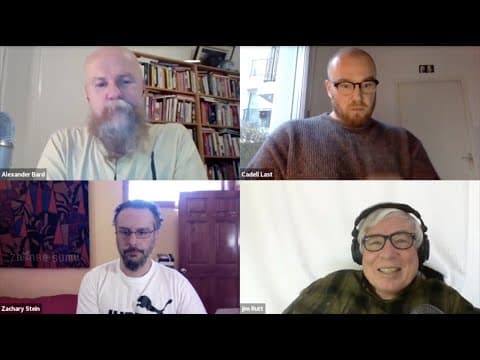
Game B Meets the Dark Renaissance w/ Jim Rutt, Zak Stein, Alexander Bard, and Cadell Last
The Observer
Digital philosophy, syntheism, netocracy — post-capitalist ontology, process theology, and the social power of networked intelligence
The Translation
AI-assisted summaryFamiliar terms
Alexander Bard proposes a genealogy of civilizational crisis that refuses the conventional separation of technological catastrophes into discrete historical events. Hiroshima, the internet, climate change, and nuclear proliferation under authoritarian regimes are not parallel problems — they are phase expressions of a single underlying condition: the recursive acceleration of technological capacity without corresponding development of the normative and institutional frameworks required to govern it.
The argument carries a specific ontological weight. Bard does not claim that humans are biological organisms who happen to use technology. The claim is stronger: technology — beginning with language understood as an information-processing system — is constitutive of the human. We are not prior to our tools; we are partly made by them. This means the question of how civilizations relate to their technologies is not a domain within philosophy or politics. It is the foundational question from which those domains derive their urgency.
This reframes both the Game B and Dark Renaissance projects as responses to the same underlying diagnosis. Both are attempts to articulate what kind of social, cognitive, and institutional architecture is adequate to a species that has entered a Technological condition not by deliberate choice but by ontological nature. The crises are not anomalies to be corrected; they are symptoms of a civilizational form that has not yet metabolized what it has already become.