
Living Beings as Whirlpools in a Dissociating Universal Mind
You cannot carry a whirlpool home.
Living beings are not things but processes — whirlpools in the river of a universal mind. The boundary between self and world is a dissociative act, not a fundamental division, and nature demonstrates this fractally: what happens between us mirrors what happens between alter personalities in a shared dream.
The Source
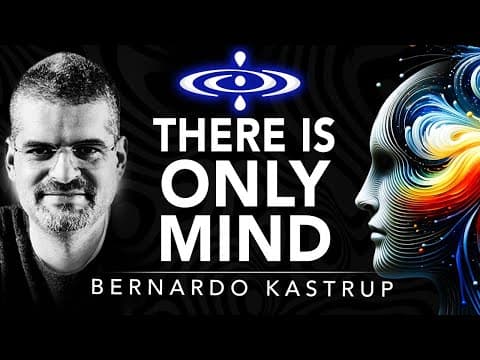
Bernardo Kastrup - The Radical View of Mind Only | Elevating Consciousness Podcast #46
The Observer
The Translation
AI-assisted summaryFamiliar terms
Bernardo Kastrup's analytic idealism reframes living organisms not as material objects inhabiting a physical world but as processes — localized excitations within a universal phenomenal field. The whirlpool metaphor is central: a whirlpool has discernible boundaries and stable structure, yet it possesses no substance independent of the river. It is not a thing but a doing. Metabolism, self-organization, biological identity — all are patterns of activity within mind-at-large, not entities separable from it. The apparent solidity of individual existence is, on this account, a Category error: mistaking a process for a substance.
The dissociative boundary is the mechanism proposed for how one universal mind becomes many seemingly private experiential centers. Just as dissociative identity disorder partitions a single psyche into alter personalities — each with its own first-person perspective, memories, and even distinct physiological markers — so nature dissociates into individual conscious agents. Research conducted at Harvard documented that alters in DID patients can share dreams: each alter experiences the dream from its own vantage point, perceives the others as objectively present, and independently corroborates the shared narrative. This is not offered as mere metaphor but as a structural isomorphism.
The fractal principle completes the architecture. The same dissociative dynamics observable at the clinical scale are proposed to operate at the cosmological scale. If individual minds are alters of a universal mind, then intersubjective reality — this conversation, this shared world — is precisely what a shared dream looks like from the inside. The personal and the cosmic are not analogous by coincidence; they instantiate the same pattern at different levels of nature's self-similar hierarchy.