
Mapping Reality for Meaningful Choice
To build on stone, not sand
Before any wise action or meaningful choice is possible, one must first answer: what is real? Sense-making is not a luxury or an intellectual hobby — it is the foundational act of orienting oneself in reality, and the prerequisite to everything else.
Actions
The Source
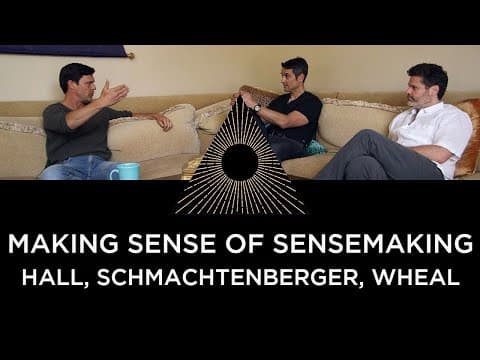
Making Sense of Sensemaking: Daniel Schmachtenberger, Jamie Wheal, Jordan Hall
The Observer
Systems thinking, meta-crisis, civilizational risk — sensemaking, existential risk, and the structural drivers of civilizational collapse
The Translation
AI-assisted summaryFamiliar terms
This framework positions Sense-making not as an epistemic practice among others, but as the foundational condition for any coherent agency. The argument is precise: because meaningful choice is always choice within a context, the quality of one's map of reality directly determines whether intentions translate into outcomes aligned with one's actual values. A systematically distorted model of the world produces systematically misaligned action — regardless of the sophistication of the planning layered on top of it.
The philosophical move here is to bind meaning to reality rather than to preference or narrative. What is meaningful is not simply what feels significant, but what is significant in relation to what is actually the case. This collapses the common distinction between 'getting the facts right' and 'deciding what matters' — the two are structurally interdependent. Orienting one's choices requires simultaneously interrogating one's ontological commitments: What exists? What is my relationship to it? What follows from that for how I act?
The framework then extends this individual challenge into a collective one. The question of Sense-making together is framed as a question of how distributed agents — each with partial, perspectival models — can converge on a shared orientation that is genuinely responsive to their actual environment. This is not merely a coordination problem in the game-theoretic sense; it is a deeper question about the conditions under which a group can act as a coherent 'we' without sacrificing the epistemic honesty that makes collective action effective rather than merely coordinated.