
Matter as Dashboard: Why Quantum Physics Points to Idealism
The sky is still there. It just isn't physical.
What we call matter has no standalone existence — it is a dashboard readout of deeper mental states. Quantum experiments, confirmed by a 2022 Nobel Prize, have shown for decades that physical properties don't exist prior to measurement. The resistance to this conclusion is cultural, not scientific.
The Source
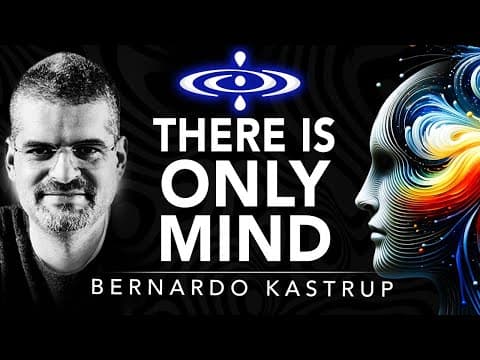
Bernardo Kastrup - The Radical View of Mind Only | Elevating Consciousness Podcast #46
The Observer
The Translation
AI-assisted summaryFamiliar terms
Analytic idealism reframes the Ontological status of matter: rather than being the fundamental substrate of reality, matter is a representation — an appearance that mental states take when perceived or measured. The dashboard analogy is instructive. An airplane's instruments translate atmospheric conditions into dial readings for the pilot. Similarly, perception translates transpersonal mental activity into the spatiotemporal, quantitative language we call "the physical world." When no measurement occurs, no physical representation is generated, but the underlying mental reality persists. Physicality is thus epistemically downstream of mentality, not the other way around.
This position draws direct support from experimental quantum mechanics. Bell test experiments, beginning with Aspect's work in 1982 and culminating in the loophole-free tests recognized by the 2022 Nobel Prize in Physics, have conclusively ruled out local hidden variable theories. The implication is stark: there are no definite physical properties prior to measurement. The measured world does not pre-exist its measurement in any physically meaningful sense. This is not an interpretive gloss — it is what the violation of Bell inequalities formally entails.
Despite this, the dominant intellectual culture continues to resist the idealist reading. Theoretical constructs such as the many-worlds interpretation or superdeterminism are invoked to preserve physicalist ontology, yet none of these alternatives carry independent empirical support. They are metaphysical rescue operations, not scientific theories. The argument advanced here is that the barrier to accepting idealism is not evidential but cultural — a deep institutional and psychological commitment to physicalism that persists in spite of, not because of, what nature has been demonstrating for decades.