
McGilchrist's Philosophical Intuitions Preceded His Neuroscience
The joke was already dead before the lab coat arrived.
McGilchrist's thesis about left-hemisphere dominance didn't originate in neuroscience — it was prefigured decades earlier in philosophical intuitions about how analytical attention destroys the living things it tries to grasp, first articulated in his 1982 book on literary criticism.
Actions
The Source
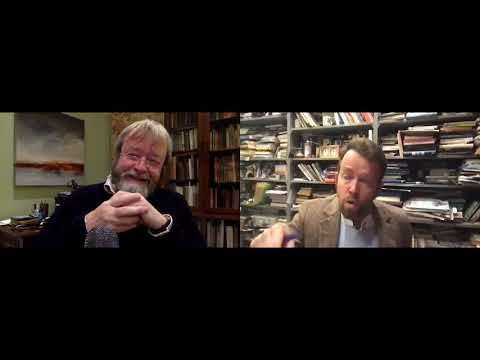
Attention as a moral Act: Iain McGilchrist & Jonathan Rowson in Conversation
The Observer
Hemisphere theory, neuroscience, philosophy of mind — left and right brain as modes of being, the crisis of left-hemisphere dominance, and the nature of consciousness
The Translation
AI-assisted summaryFamiliar terms
McGilchrist's intellectual autobiography reveals a striking fact about the genesis of his hemispheric thesis: it was not derived from neuroscience but prefigured in philosophical convictions he traces to early adolescence. Before encountering any brain science, he had already concluded that wholes exceed the sum of their parts, that reality is participatory rather than inert, that opposites tend toward coincidence, that history spirals rather than progresses linearly, and that analytic attention destroys what it dissects. His 1982 book Against Criticism gave these intuitions their first systematic expression, arguing that literary criticism is structurally self-defeating — it abstracts the contextual, generalizes the unique, and makes explicit what functions only as implicit, thereby annihilating the living phenomenon it claims to illuminate.
This is not merely a biographical curiosity; it is architecturally central to understanding The Master and His Emissary. The left hemisphere's characteristic operations — decontextualization, categorization, explicit representation — are precisely the operations McGilchrist had already identified as destructive in the domain of literary understanding. The neuroscience provided a biological substrate for a philosophical diagnosis that was already fully formed. The hemispheric model didn't generate the insight; it grounded it.
The encounter with Oliver Sacks's Awakenings served as a methodological turning point, demonstrating that rigorous attention to the particular case — the clinical vignette, the irreducible individual — could carry philosophical weight without the reductive extraction that kills meaning. Sacks modeled a form of science that allowed truth to remain implicit in narrative rather than being abstracted into proposition. This became McGilchrist's own methodological commitment: to think with the particular rather than against it.