
Open-Sourcing Ecstasy Against Institutional Gatekeeping
Fire for every hearth, light for every mind
Non-ordinary states of consciousness are not a fringe curiosity — they are a foundational technology of civilization, repeatedly rediscovered and repeatedly suppressed. The only defense against suppression is radical decentralization: make the tools available to everyone.
Actions
The Source
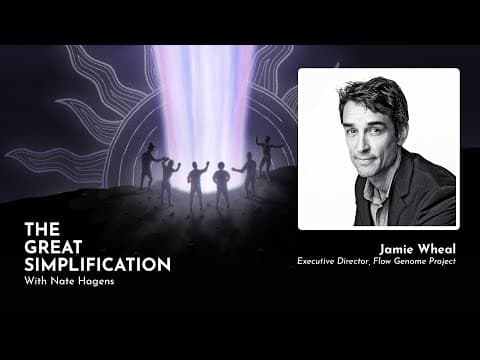
Jamie Wheal: “Neuro-anthropology and Culture Architecture” | The Great Simplification #13
The Observer
Flow states, peak performance, ecstatic experience — neuroscience of consciousness, collective sensemaking, and civilizational meaning-making
The Translation
AI-assisted summaryFamiliar terms
Jamie Wheal's framework identifies a long-running civilizational dialectic between what he terms Prometheans — those who have historically leveraged Non-ordinary states of consciousness to seed cultural renewal, epistemological breakthroughs, and meaning-making — and the institutional authorities who have repeatedly moved to suppress or co-opt those same capacities. The lineage runs from the Eleusinian Mysteries through Sufi ecstatic practice, through the Harvard Psilocybin Project and MK-Ultra, through Burning Man and the contemporary psychedelic renaissance in clinical neuroscience.
The central thesis is that non-ordinary states are not a peripheral phenomenon but a foundational cognitive technology — one that civilizations have repeatedly rediscovered as a mechanism for Collective sense-making, creative breakthrough, and the renovation of shared meaning structures. Mircea Eliade's framing of shamanic practice as "Techniques of ecstasy" provides a useful historical anchor: these are learnable, transmissible methods, not mystical accidents. The suppression of these techniques by institutional authority — whether ecclesiastical or governmental — is therefore not incidental but structurally predictable, since they represent a competing locus of epistemic authority and social cohesion.
The strategic implication Wheal draws is that open-sourcing these techniques — radically decentralizing access to the underlying practices rather than allowing them to be gatekept by any therapeutic, religious, or governmental institution — is the only historically robust defense against their recurring suppression. Decentralization functions here not merely as an ethical preference but as a resilience strategy: if no single node controls access, no single authority can extinguish the flame.