
Personal Healing Does Not Automatically Repair a Broken World
The glaciers don't care that you did the work.
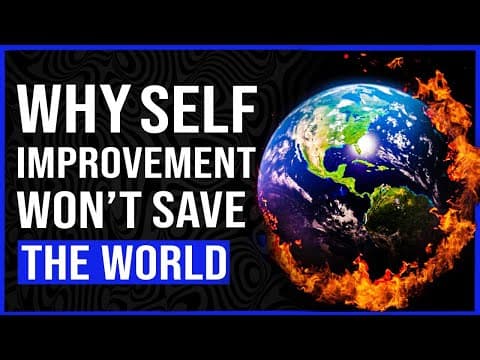
The assumption that healing individuals automatically heals the world rests on a hidden philosophical error — that civilization is merely the sum of its members' interior states. The trauma-processing boom may function less as a path to collective repair than as a socially sanctioned way of looking away from crises too large to face.
The Observer
The Translation
AI-assisted summaryFamiliar terms
The self-improvement and trauma-processing movements carry a buried metaphysical commitment: methodological individualism applied to civilizational health. The premise is that the world is nothing more than the aggregate of individual interior states, so improving those states mechanically improves the collective exterior. This premise is not argued for — it is simply assumed. And the empirical record offers no support: the explosive growth of inner-child work, somatic therapy, and trauma processing over the past thirty years has coincided with the deterioration of nearly every civilizational metric, from ecological stability to institutional trust to democratic function. The glaciers are indifferent to anyone's attachment style.
The argument is not that inner work lacks value but that it has been category-mistaken for a sufficient response to problems that exceed the sum of personal wounds. One of the structural consequences of deep absorption in one's own trauma narrative is that the exterior world recedes from attention. If the operating assumption is that collective repair follows automatically from individual healing, the result is a kind of distributed paralysis — millions of people doing sincere interior work while the shared crisis accelerates unattended.
The timing is not incidental. The trauma industry has scaled to its current size at exactly the historical moment when the magnitude of external threat has become psychologically unbearable. This suggests a functional reading: trauma processing serves, in part, as a socially legitimized grief bypass — a mechanism for deferring confrontation with civilizational decline under the appearance of doing rigorous, necessary work. The permission structure is nearly airtight, which is precisely what makes it worth examining.