
Psychology as the Hinge Between Science, Meaning, and Myth
The garden where logos learned to grieve
Science deliberately brackets subjectivity and value to produce objective knowledge, but this leaves civilization without answers to its most urgent questions — what to build, how to live. Psychology, spanning natural science, social science, and humanities, becomes the hinge discipline through which a unified knowledge system can reconnect what is with what ought to be.
Actions
The Source
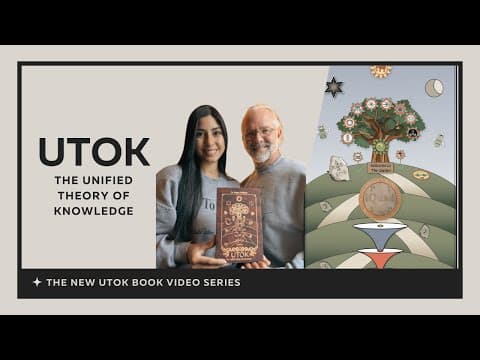
The New UTOK Book | Ep 8 | The UTOK Garden frames the Intersubjective Vector of Knowing (Ch 6)
The Observer
UTOK framework, integrative metatheory — epistemology, philosophy of mind, and systems thinking in clinical psychology
The Translation
AI-assisted summaryFamiliar terms
C.P. Snow's 'Two Cultures' diagnosis identified a fracture at the heart of modern knowledge: the sciences and the humanities drifted apart, each unable to speak the other's language. The deeper structural issue is that science, by design, factors out subjectivity and value to produce intersubjective, objective knowledge — what Ken Wilber and others have called the 'It' language. This is not a deficiency but a constitutive feature. The consequence, however, is that science is structurally silent on the questions that most urgently orient civilizations: questions of meaning, purpose, and the good. These belong to the domain of Mythos — the narrative architectures through which cultures project themselves toward futures not yet realized.
Mythos is not opposed to Logos but complementary to it. Logos maps what has been and what is. Pathos — the felt, phenomenological dimension — grounds knowledge in lived experience. Mythos integrates both into an ethos, a shared directional orientation toward what ought to be. The present danger is a Mythos vacuum: legacy narrative structures are disintegrating faster than coherent replacements emerge, leaving civilizational orientation in crisis.
Psychology occupies a uniquely bridging position across the three great domains of knowledge — connecting downward to the natural sciences through neuroscience and behavioral research, outward to the social sciences, and inward to the humanities through phenomenology, clinical encounter, and ethical reasoning. The clinician is compelled to honor first-person authority, navigate value conflicts, and apply empirical methodology simultaneously. This forced convergence makes psychology the Hinge Discipline for constructing a genuinely unified knowledge system. UTOK's Garden Framework addresses this gap not by collapsing domains but by holding them in living dialectical relation — binding what is to what ought to be.