
Relevance as the Binding Force Between Mind and World
You cannot step outside the belonging.
Intelligence works not by processing everything but by ignoring almost everything — zeroing in on what's relevant. But relevance is neither purely subjective nor objective; it lives in a deeper space between self and world, and losing contact with that space is the central crisis of modern knowing.
Actions
The Source
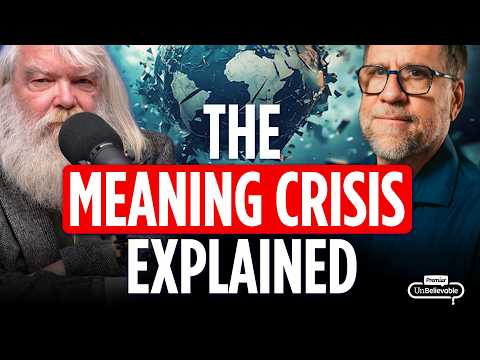
The Crisis of Meaning: John Vervaeke and Malcolm Guite hosted by John Nelson
The Observer
Cognitive science, relevance realization, meaning crisis — 4E cognition, consciousness, and the recovery of wisdom
The Translation
AI-assisted summaryFamiliar terms
At the foundation of all cognition lies what John Vervaeke identifies as a meta-problem: the problem of Relevance realization. Before any problem can be solved, the situation must be framed — and framing requires selecting from a combinatorially explosive space of possible patterns, memories, and projections. Intelligence is not comprehensive processing; it is radical, skillful ignoring. The question then becomes: what governs this selection? Relevance is neither purely subjective nor purely objective. You can be mistaken about it, which rules out mere subjectivity. Yet nothing is relevant in all contexts, which rules out pure objectivity. Drawing on William Desmond's concept of the "transjective" and the metaxu — the between-space — this insight locates relevance in a dimension that is before, beneath, between, and beyond the subject-object dichotomy.
Truth and relevance exist in something like Heisenberg complementarity: relevance constrains what we take to be true, while truth corrects what we take to be relevant. There is no stepping outside both simultaneously. The "View from Nowhere" is not merely difficult but logically impossible — a point converged upon by Gödel's Incompleteness, Einstein's relativity, and Heisenberg's uncertainty.
What traditional cultures called myth was the imaginal apprehension of this metaxu — the participatory fitting-together of self and world that enables fundamental belonging. This is the original meaning of Religio: binding, commitment. The Cartesian revolution promised a universal method that required no such binding — no personal transformation, no existential commitment for truth to be disclosed. That severance from the transjective is the deep source of the modern Meaning crisis, and recovering it requires not nostalgia for pre-modern cosmologies but a post-critical reintegration of relevance, truth, and participatory knowing.