
Religion as Participatory Knowing, Not Primitive Belief
You cannot avoid having a bottom.
There is a natural stack of inquiry descending from science through philosophy to religion. Religion is not where you ask the deepest questions — it is where you participate in the deepest life. Everyone operates from an ultimate framework; the only choice is whether to do so consciously or unconsciously.
The Source
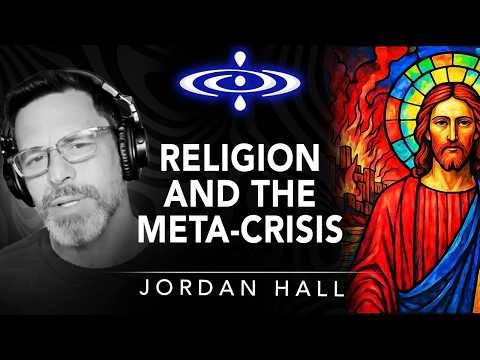
Jordan Hall - Rethinking Religion at the Edge of Collapse | Elevating Consciousness Podcast #57
The Observer
Jordan Hall is a serial tech entrepreneur and systems thinker who co-founded DivX Networks before shifting focus to civilizational-scale questions. He is a central architect of the Game B intellectual movement, which pro
The Translation
AI-assisted summaryFamiliar terms
This insight proposes a natural stack of inquiry: computer science, economics, philosophy, and finally religion — each layer addressing progressively deeper questions. The critical move is recognizing that the transition from philosophy to religion is not a transition between different kinds of questions but a categorical shift from propositional knowing to participatory knowing. Philosophy operates comfortably in the propositional domain — articulating, analyzing, critiquing. But if the inquiry is followed all the way down, it arrives at a domain where the relevant mode of engagement is no longer questioning but inhabiting. Religion, on this account, is not where you ask the deepest questions the tradition permits; it is where you participate in the deepest life.
This reframes the standard modern dismissal of religion. The metacritic who treats religious commitment as intellectually naive or as a coping mechanism for those who cannot handle ambiguity has, from this vantage point, simply failed to descend the full stack. They have confused the sophistication of their questions with the depth of their engagement. The capacity to ask penetrating questions is not identical to the capacity to live from penetrating answers — and the latter is the harder, deeper achievement.
The argument carries a strong universalist implication: there is no non-religious position. Every person operates from some reserved perspective — a set of primary values and purposes that conditions all subsequent evaluation. That reserved perspective functions as religion regardless of whether it is labeled as such. The distinction is not between the religious and the secular but between the consciously religious and the unconsciously religious. Those who believe they have transcended religion have typically only rendered their operative religion invisible to themselves.