Self-Organization and the Spontaneous Origins of Life
Selection polishing the pre-carved gems of physics
Darwin's natural selection is real but incomplete — self-organization generates biological order for free, from physics and chemistry alone, and evolution works with that pre-existing order rather than conjuring complexity from nothing.
The Translation
AI-assisted summaryFamiliar terms
Stuart Kauffman's central challenge to the Modern Synthesis is that Darwinian natural selection, while necessary, is radically insufficient as an explanation for biological order. The standard account treats selection as the sole architect of complex adaptive structure, but Kauffman argues this neglects a second, independent source of order: Self-organization. These are not competing explanations but complementary ones, and conflating selection with the totality of order-generating processes in biology has led to a systematically impoverished picture of life.
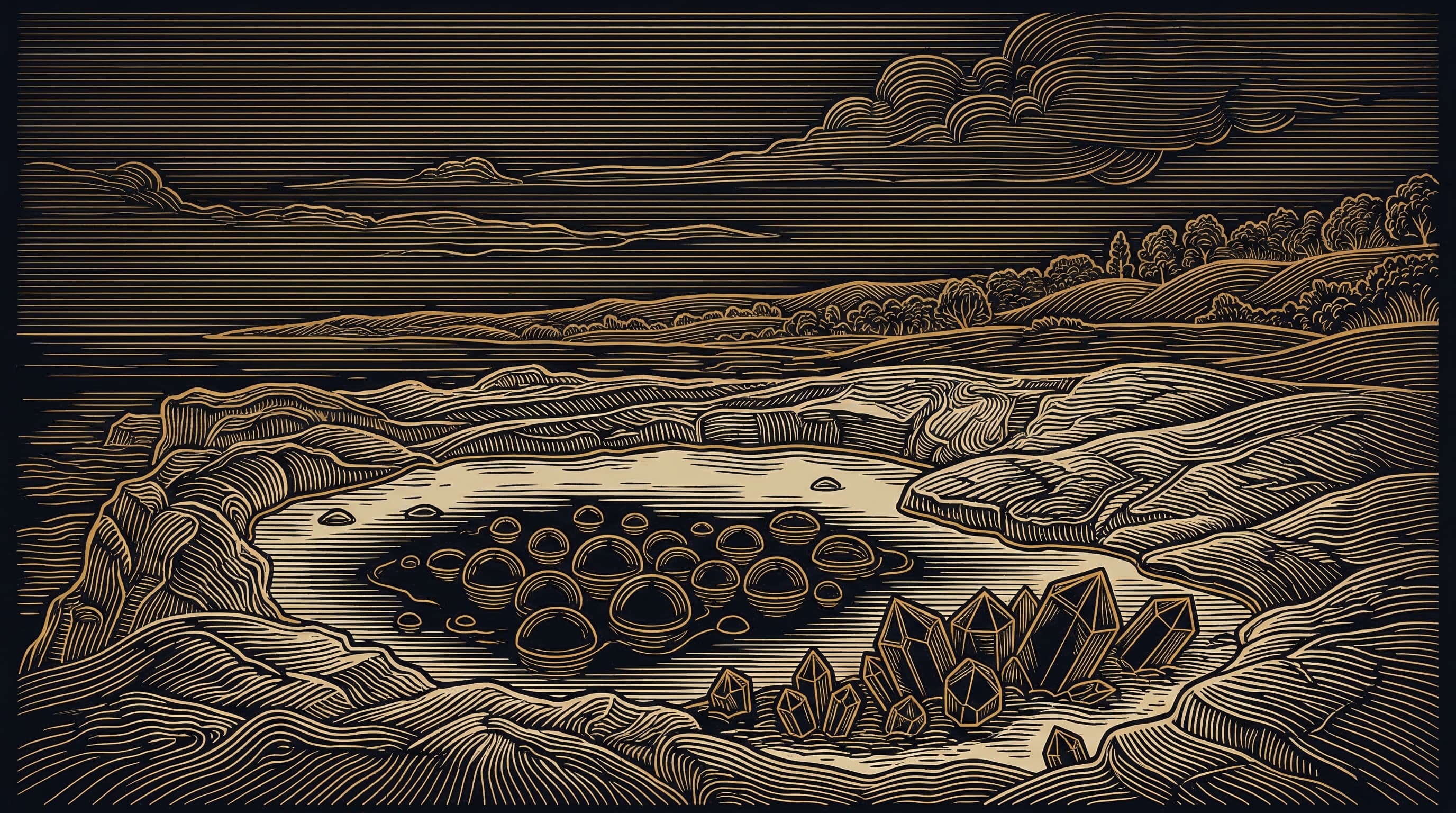
The evidence spans multiple levels. Thermodynamic and geometric constraints produce order without selection — lipid bilayers self-assemble into vesicles through hydrophobic interactions alone, offering a plausible abiotic precursor to cellular membranes. Kauffman's analysis of Random Boolean networks — abstract models of gene regulatory dynamics — demonstrated that systems with thousands of binary nodes, connected randomly, spontaneously converge on a tiny subset of possible states, cycling through stable attractors. This order is intrinsic to the network topology, not imposed by selection. The number of attractors scales approximately with the square root of the number of nodes, a regularity that maps surprisingly well onto observed cell-type diversity across organisms.
The theoretical reframing is significant. If Self-organization pre-structures the space of viable biological forms, then natural selection operates not on a flat, featureless landscape of possibilities but on one already sculpted by physical and chemical necessity. Selection explores and refines order it did not create. This positions Kauffman's work within a broader research program — sometimes called complexity theory or the science of Emergence — that seeks to identify the general principles by which order arises spontaneously in complex systems, with Darwinian evolution as one powerful but partial mechanism within that larger framework.