
Structural Failure Modes of Collective Sensemaking
Skid marks on the road to utopia
Every generation trying to build a better way of thinking and acting together keeps failing in the same ways. Understanding why collective intelligence efforts collapse — and what would let them actually succeed — may be the most urgent problem of our time.
Actions
The Source
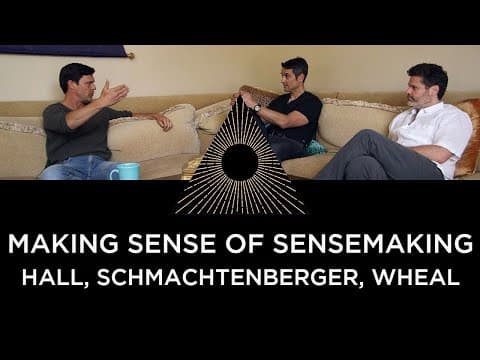
Making Sense of Sensemaking: Daniel Schmachtenberger, Jamie Wheal, Jordan Hall
The Observer
Flow states, peak performance, ecstatic experience — neuroscience of consciousness, collective sensemaking, and civilizational meaning-making
The Translation
AI-assisted summaryFamiliar terms
A recurring observation within the metacrisis and Game B discourse is that transformational culture — the broad ecosystem of actors attempting to instantiate post-conventional forms of Collective intelligence and Collective sense-making — exhibits a troubling pattern of structural recidivism. Rather than failing forward, iterating on the characteristic errors of prior countercultural waves, successive generations of meaning-making communities reproduce the same Achilles' heels: epistemic closure, charismatic capture, in-group rivalrous dynamics, and the collapse of the very coherence mechanisms they were designed to cultivate.
This matters because the problems driving the metacrisis are genuinely wicked in the technical sense — high-dimensional, interdependent, resistant to decomposition into tractable sub-problems. They exceed the cognitive bandwidth of individual agents operating in competitive isolation. The theoretical solution space points clearly toward higher-order Collective intelligence: distributed Sense-making architectures that can hold complexity no single mind can model. But the practical attempts to build such architectures keep reproducing the dysfunctions they were meant to transcend.
The insight here is that identifying the precise rate-limiting failure modes — the structural vulnerabilities that cause Group coherence to destabilize under real-world conditions — is not peripheral to the project of civilizational renewal. It is load-bearing. Without a rigorous phenomenology of collective collapse, efforts to build more adequate group epistemics remain vulnerable to the same attractors that have swallowed every prior attempt.