
The Shift from Attention to Awareness as Civilizational Precondition
The party no one knew they were missing
The flip is a shift from attention — where a self looks out at objects — to awareness itself: vast, open, and not located in any individual. This experiential shift, not merely intellectual, is the precondition for building genuinely post-growth ways of living.
Actions
The Source
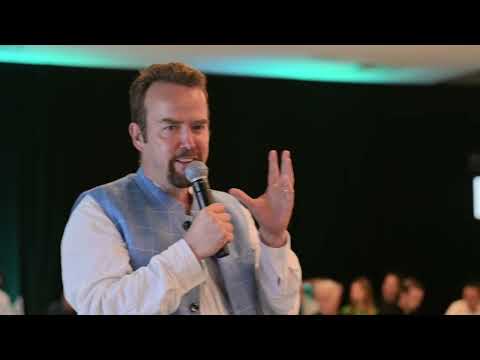
The Flip, the Formation, and the Fun: A response to the Metacrisis by Jonathan Rowson, in Montreal.
The Observer
Systems thinking, inner life, cultural transformation — sensemaking, dialogos, and the soul’s role in navigating civilizational crisis from Perspectiva
The Translation
AI-assisted summaryFamiliar terms
The flip names an experiential transition from attention — the subject-object structure in which a localized self attends to discrete phenomena — to awareness as such: the unbounded, non-localized field within which all attending occurs. This is not a philosophical proposition to be debated but a perceptual shift to be undergone. Phenomenological pointers like Douglas Harding's finger-pointing exercise or the pen-pointing inquiry function as invitations to notice what is structurally present but habitually overlooked: that first-person experience, examined carefully, does not disclose a bounded observer but an open capacity. The shift is always already available; it simply goes unattended.
Historically, the Axial Age (roughly 800–200 BCE) represents a documented precedent for collective transformation in how consciousness relates to itself. Under pressures of urbanization, monetization, and large-scale warfare, human beings across disconnected civilizations — India, China, Greece, the Near East — simultaneously developed reflexive interiority, the sense of being a self that looks out at the world. The Buddha, Laozi, Heraclitus, and the Hebrew prophets emerged from this same crucible. The argument is not for repetition but for recognition: shifts in the deep structure of self-understanding have occurred at civilizational scale before.
The political and economic stakes follow directly. If the default operating assumption remains that consciousness is insular and consumption-oriented, then post-growth frameworks will be experienced as deprivation — morally necessary perhaps, but never genuinely desirable. The flip dissolves the assumption at its root. Once the sense of being a separate self competing for scarce satisfactions loosens, the question of what life is for reopens authentically. A post-growth orientation then becomes not an ascetic obligation but a more compelling way of being — a party worth attending on its own merits.