
UTOK's Core Symbols as Orientation Tools, Not Arguments
The coin turns, and you see yourself whole.
UTOK's central mantra — 'marry the coin to the tree in the garden under God' — is not poetry but a compressed map: it places first-person identity inside a scientific picture of cosmic complexity, then orients the whole structure toward goodness, truth, and beauty, bridging fact and value in a single gesture.
Actions
The Source
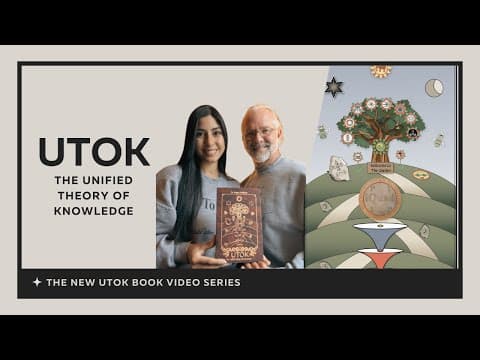
The New UTOK Book | Episode 1 | An Introduction to the UTOK Book Series
The Observer
UTOK framework, integrative metatheory — epistemology, philosophy of mind, and systems thinking in clinical psychology
The Translation
AI-assisted summaryFamiliar terms
The UTOK mantra — 'marry the coin to the tree in the garden under God' — functions as a compressed metatheoretical map rather than a rhetorical device. Each term indexes a distinct knowledge technology developed by Gregg Henriques. The coin encodes a Figure-Ground Reversal of identity: read as H (Human) or rotated to I (Identity), it forces the holder to oscillate between subjective selfhood and the recognition that one is simultaneously an energy-information object, a living organism, a minded animal, and a cultured person — nested ontological layers tracked by the Tree of Knowledge system.
The Tree of Knowledge itself is a macro-level framework that maps reality's Complexification across four joint points: Matter, Life, Mind, and Culture. Marrying the coin to the tree is the act of placing phenomenological first-person experience into correct epistemic relation with this third-person scientific architecture. What emerges from that marriage is the garden — a Justification network in which empirical facts and normative values are not segregated but Co-constitutive, dissolving the classical is–ought gap through structural integration rather than philosophical argument.
'Under God' supplies the axiological orientation. It is not a theological commitment but a meta-ethical one: the garden of justified knowledge must be aimed toward transcendent attractors — goodness, truth, and beauty — or it collapses into incoherence. This is precisely why the UTOK framework could not remain within the conventions of peer-reviewed academic publishing. The coin and the garden are not propositional claims subject to standard falsification; they are orienting instruments — archetypal, paradigmatic, and idiographic simultaneously. Scientific rigor, fully pursued to its metatheoretical limit, eventually requires a vessel adequate to what it discovers, and that vessel is necessarily different in kind from the journal article.