
Why Science Cannot Capture the Individual Psyche
The residual is the whole point.
Science works by generalizing across cases, but the psyche is precisely what gets left out — the unique, first-person perspective that no statistical model captures. This is not a flaw to fix but a fundamentally different kind of knowing that must be held alongside science, not collapsed into it.
This observation is part of a broader exploration: The Psyche as the Remainder Science Cannot Capture.
The Source
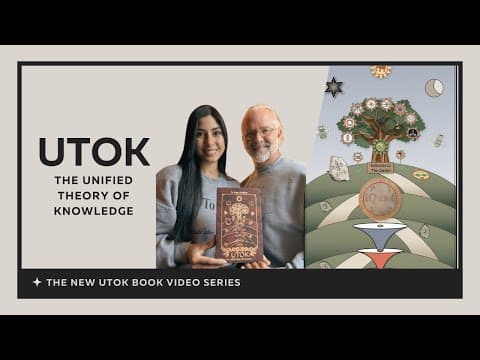
The New UTOK Book | Episode 5 | The Four Great Problems Addressed by UTOK (Ch 3)
The Observer
Gregg Henriques is a Full Professor of psychology at James Madison University who developed the Unified Theory of Knowledge — a comprehensive meta-framework mapping reality across four planes (Matter, Life, Mind, and Cul
The Translation
AI-assisted summaryFamiliar terms
Science achieves its power through nomothetic generalization — extracting lawful regularities across cases while treating individual variance as residual noise. But this very design principle means that what is most meaningful to the individual — the idiographic, qualitative, first-person cascade of particular events constituting a life — is systematically excluded from scientific explanation. The residual in a regression model is not mere measurement error; it is the signature of irreducible particularity. Gravity, Operant Conditioning, and natural selection may be causally operative, but no generalizable law accounts for why this specific configuration of events unfolded for this specific person.
The psyche, understood as the unique phenomenological perspective of being-in-the-world, is therefore not merely a difficult scientific object but a categorically different form of information. It operates under different rules of legitimation — interior rather than exterior, qualitative rather than propositional, singular rather than generalizable. Chalmers' hard problem of consciousness illuminates this same structural gap: subjective experience resists materialist reduction not due to any supernatural quality but because first-person phenomenology constitutes a distinct epistemic vector that cannot be collapsed into third-person description without destroying its essential character.
UTOK addresses this not by attempting integration through reduction but by maintaining both domains in structured relation. The Tree of Knowledge maps the exterior, generalizable architecture of behavioral complexity across matter, life, mind, and culture. The Coin represents the interior, phenomenological perspective of the individual knower. The critical intellectual move is holding these two forms of knowing in productive tension — married but not merged — recognizing that a complete account of human existence requires both without privileging either.