
Why the Comet in Don't Look Up Is a Metaphor, Not an Analogy
The math is done. The sky is full.
The comet in Don't Look Up fails as an analogy for climate change but succeeds brilliantly as a metaphor — not for the threat itself, but for the experience of knowing a catastrophe is underway while living inside systems structurally incapable of responding to that knowledge.
Actions
The Source
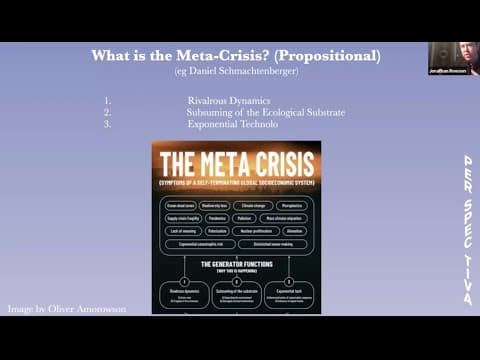
Don’t Look Up! The Meta-Crisis Is Not in the Sky w/ Jonathan Rowson
The Observer
Systems thinking, inner life, cultural transformation — sensemaking, dialogos, and the soul’s role in navigating civilizational crisis from Perspectiva
The Translation
AI-assisted summaryFamiliar terms
The dominant critical response to Don't Look Up evaluated the film on whether a comet serves as a credible analogy for climate change, and largely concluded it was too simplistic. This critique, however, rests on a Category error between analogy and metaphor. An analogy demands structural correspondence: is the problem-type the same? By that standard, a comet — a discrete technical challenge with a binary outcome — maps poorly onto climate change, which is an adaptive challenge embedded in economic systems, cultural practices, and institutional inertia. The two problems operate at fundamentally different scales of complexity.
But a metaphor functions differently. It illuminates experiential or structural truths without requiring isomorphic correspondence. Read as metaphor, the comet becomes extraordinarily potent: it renders viscerally legible the phenomenology of living inside a reality-avoidant civilization. The science is settled, the trajectory is observable, and yet every institutional layer — political, media, corporate — metabolizes the threat according to its own operative logic rather than the logic of the threat itself. Politicians optimize for electoral advantage, media for engagement, capital for extraction. The result is not ignorance but systemic inability to convert verified knowledge into coordinated action.
This reframing shifts the film's lesson considerably. Climate change is not analogous to a future impact event; it is an already-unfolding disruption whose default trajectory leads to serious civilizational consequences. The operative question is not prevention but interception of the worst scenarios, and that capacity depends on addressing what might be called the metacrisis — the deeper structural and cultural dysfunction that prevents collective systems from responding proportionately to known existential-scale threats. The film's real subject is not the comet. It is the gap between knowledge and institutional response.