
Why the Sacred Cannot Be Engineered from Its Parts
You cannot manufacture an arrival.
You cannot engineer the sacred, because engineering demands you already know what you are building toward — but the sacred, by definition, arrives as what you did not already possess. Meaning recovers not through synthesis but through genuine dialogue between living traditions.
Actions
The Source
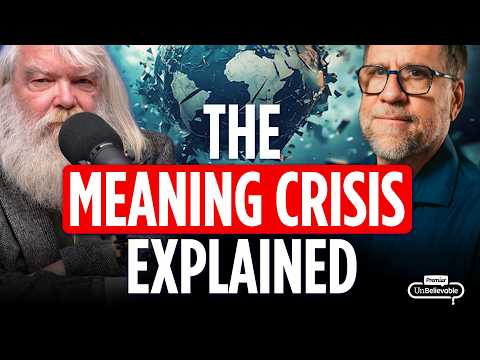
The Crisis of Meaning: John Vervaeke and Malcolm Guite hosted by John Nelson
The Observer
Cognitive science, relevance realization, meaning crisis — 4E cognition, consciousness, and the recovery of wisdom
The Translation
AI-assisted summaryFamiliar terms
John Vervaeke has publicly acknowledged what he now considers a profound error in his earlier approach to the Meaning crisis: the attempt to reverse-engineer religion by extracting its functional components — community, transformative practices, ecology of wisdom cultivation, the enhancement of Religio — and reassembling them into something new, stripped of historical and doctrinal baggage. He recognizes this as an ironically modernist move, one that reproduces the very instrumental rationality responsible for the crisis it seeks to address. The core problem is that Logos cannot be manufactured. If you attempt to engineer it, you throttle it, because Logos must emerge of its own accord and take on a life of its own.
This connects directly to Hartmut Rosa's concept of resonance, whose defining characteristic is uncontrollability. The moments of deepest significance — an unexpected encounter, a turn in genuine dialogos that calls you beyond your current horizon — are precisely those that cannot be predetermined. The sacred, by structural necessity, arrives as that which you did not already possess. Engineering presupposes a known target; the advent of the sacred presupposes the absence of one. These two orientations are fundamentally incompatible.
The practical implication is that addressing the Meaning crisis requires not a synthetic construction project but the cultivation of conditions under which the sacred can show up. This means bringing the living traditions — their ecologies of practices, their wisdom cultivation, their capacities for Religio — into genuine dialogos with one another. The aim is mutual deepening, not dissolution: Buddhism helping Christians recover dimensions of their own tradition, Christianity doing the same for Buddhism. No tradition is reduced to a component in a universal method. Each is renewed through the encounter itself.